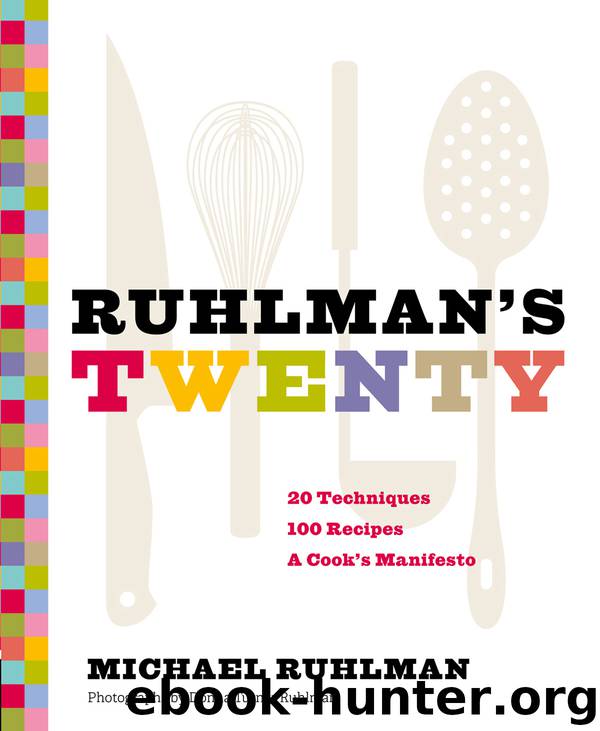
Ruhlman's Twenty by Michael Ruhlman
Author:Michael Ruhlman
Language: eng
Format: epub, mobi
ISBN: 978-1-4521-1045-5
Publisher: Chronicle Books LLC
Soon all of the preceding will be too easy for you, and you’ll want to make the sauce even better. After the final deglazing, pass the sauce through a fine-mesh strainer into a small saucepan. Now you have a very fine sauce, and you can refine it further. Swirl in some butter to enrich it and give it a voluptuous texture. Sweat a little minced shallot in the saucepan before you strain the sauce into it. Adjust the consistency with a couple of teaspoons of beurre manié or a cornstarch/cornflour slurry. Stir in some finely minced herbs—fines herbes are a common and delicious pairing: parsley, tarragon, chervil, and chives. Taste your sauce again for seasoning and acidity.
Once you do this, you’ll see that the technique works for any meat that leaves some of its browned protein and fat in the pan. Home cooks are often led to believe that in order to make great meat-based sauces, they must spend weekends laboring over enormous pots of stock and vats of steaming bones and, afterward, a piled-high sink. Not true: Some water and a pan in which you cooked meat are all you need.
A traditional hollandaise sauce is a preparation to revel in, not to fear. Like mayonnaise, hollandaise is an emulsified sauce—lots of butter emulsified into a small amount of liquid with the help of some enriching egg yolk. Many recipes use only lemon juice for flavor, but a vinegar reduction is included in the version described by Escoffier, and adds some complexity to the end flavor.
A reduction is basically a mini stock that you quickly prepare before making the sauce by combining vinegar and aromatics, cooking off the vinegar, and then reconstituting it with water.
Vegetable-based sauces are great as well. You can quickly sauté chopped mushrooms and shallots, season them with salt and pepper, deglaze the pan with white wine, and add just enough water to bring all the ingredients together. Finish with a pat of butter, and you’ve got a delicious sauce for white fish such as halibut, sautéed chicken, or grilled/barbecued meats. Add a squeeze of lemon or a pinch of curry for a tantalizing accent.
Tomato sauce is not only an excellent all-purpose sauce—it’s also a great cooking medium. I suspect it’s not prepared nearly enough at home because of the heavy marketing of tomato-sauce makers. You can’t make tomato sauce at the last minute—the fastest you can bring it together is about an hour—but tomato sauce is simple and practically cooks itself once the ingredients are in the pan. It’s little more than puréed tomatoes cooked down. You can flavor it, you can enrich it, and you can make it more complex in any number of ways.
My favorite tomato sauce is simply plum tomatoes (also known as Roma tomatoes), onion, and butter. This results in a very fresh-tasting sauce that is equally fine on pasta or as a braising liquid for pot roast. If I want more complexity, I char the tomatoes under a broiler/grill. For the recipe in this section, you can roast them in a hot oven for 20 minutes.
Download
This site does not store any files on its server. We only index and link to content provided by other sites. Please contact the content providers to delete copyright contents if any and email us, we'll remove relevant links or contents immediately.
Whiskies (Collins Gem) by dominic roskrow(45266)
101 Whiskies to Try Before You Die by Ian Buxton(45032)
World's Best Whiskies by Dominic Roskrow(44924)
Whiskies Galore by Ian Buxton(42000)
The Fast Metabolism Diet Cookbook by Haylie Pomroy(21138)
Chic & Unique Celebration Cakes by Zoe Clark(20059)
Craft Beer for the Homebrewer by Michael Agnew(18238)
The Bone Broth Miracle: How an Ancient Remedy Can Improve Health, Fight Aging, and Boost Beauty by Ariane Resnick(16605)
For the Love of Europe by Rick Steves(13967)
Tools of Titans by Timothy Ferriss(8373)
A Court of Wings and Ruin by Sarah J. Maas(7823)
Chowders and Soups by Liz Feltham(7492)
How to Be a Bawse: A Guide to Conquering Life by Lilly Singh(7478)
The Institute by Stephen King(7029)
Cravings: Recipes for All the Food You Want to Eat by Chrissy Teigen & Adeena Sussman(6786)
Wiseguy by Nicholas Pileggi(5775)
The Last Wish (The Witcher Book 1) by Andrzej Sapkowski(5461)
Spare by Prince Harry The Duke of Sussex(5186)
Room 212 by Kate Stewart(5107)
